

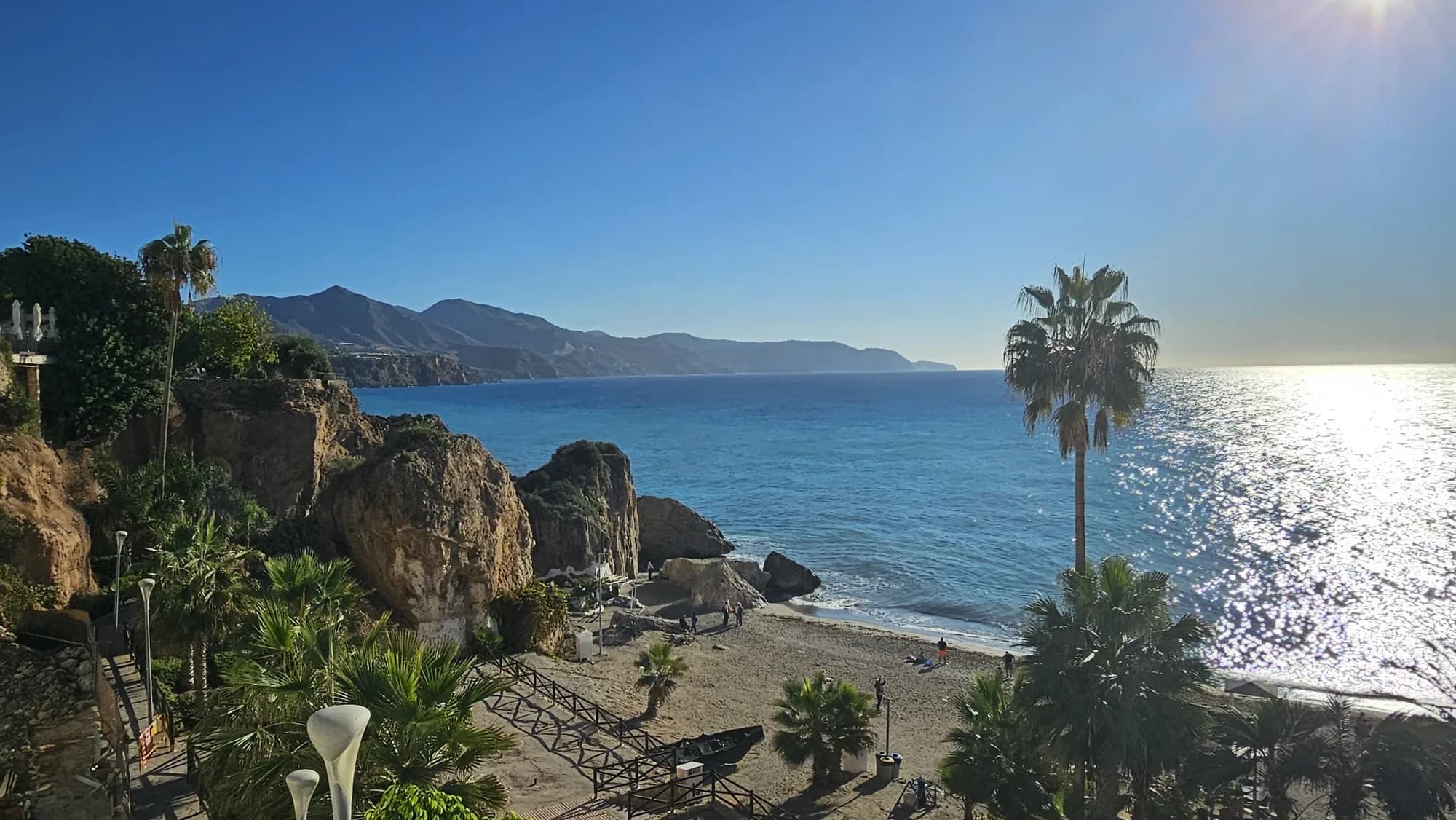
Nerja is one of those places people keep returning to after a single visit. It sits exactly where the Costa del Sol gives way to the mountains of the Axarquía, and you can see that in the town itself: white houses, narrow streets, and the sea at the end of almost every one of them. Tourism has not stripped Nerja of its character. It is still an Andalusian town where residents stroll the promenade in the evening and the baker on the corner knows his regulars.
The old centre
The heart of Nerja is the Balcón de Europa, a broad promenade jutting out above the sea like a balcony, built on the site of an old fortress. Early in the day it is quiet and the view is almost yours alone. Towards evening it fills up with street musicians, families and people simply leaning on the railing to look down at the coves.
The streets around it hold the shops, tapas bars and small squares that make Nerja such an easy place to be. Let yourself get lost for a while. Plaza Cavana, the church of El Salvador and the narrow cut throughs down to the beaches give the centre a scale that works: big enough to have something to do, small enough to walk all of it.

The beaches
Nerja has dozens of beaches, from broad stretches of sand to coves you reach only by steps. Playa Burriana is the biggest and the liveliest, with sunbeds, water sports and beach restaurants where you end up staying all afternoon for a paella cooked in front of you. Calahonda and El Salón sit directly below the centre and are ideal if you do not want to walk far.
For something quieter, drive towards Maro. The coves below the cliffs are there, with clear water and a coastline that has largely escaped development. The snorkelling is excellent, and a kayak trip along the rocks and the waterfall is the highlight of the week for many guests.

The white hinterland
What makes Nerja special is that a quarter of an hour puts you in a completely different world. Frigiliana, with its steep streets, whitewashed houses and Moorish quarter, appears on every list of the prettiest villages in Andalusia, and deservedly so. Further inland there are vineyards, walking routes through the Sierra Almijara, and villages where you will barely hear a word of English. Málaga and Granada both work well as day trips.
Sights and tips
The Nerja caves are the best known attraction in the area. The chambers of stalactites are genuinely vast, concerts are held there in summer, and on a hot day the cool inside is a relief. Book a time slot in advance during high season. Combine the visit with Frigiliana, a few minutes away, and a late lunch on a terrace there.
Beyond that: walk the cliff route at Maro, go to the Balcón before sunrise if you happen to be awake early, and if you can, plan your visit for spring or autumn. The warmth is pleasant then, there is room on the beaches and the terraces are unhurried. July and August are busy in Nerja, particularly the first two weeks of August.
The centre and the nearest beaches are an easy walk, but for Maro, Frigiliana and the rest of the area a car makes a real difference, not least because parking in high season is far simpler if you set off early. We arrange a car timed to your arrival. All the options are on our page about car hire.

Your holiday home in Nerja
The beaches, the lively centre and the calm of the hinterland make Nerja a base that is hard to tire of. If you want to rent a holiday home or apartment in Nerja, Maro or Frigiliana, you will find our range below.